Recent Blog
Category
Mutual Fund
Mutual Funds vs Bank Deposits: India’s Growth Story in Perspective
When it comes to savings and investments, bank deposits have traditionally been the go-to choice for most households. They offer safety, liquidity, and predictable returns. However, the landscape is shifting—particularly in India—where mutual funds are emerging as a strong wealth-creation vehicle.
A comparison with the United States shows us how far India has come and how much potential lies ahead.
US: Mutual Funds as Big as Bank Deposits
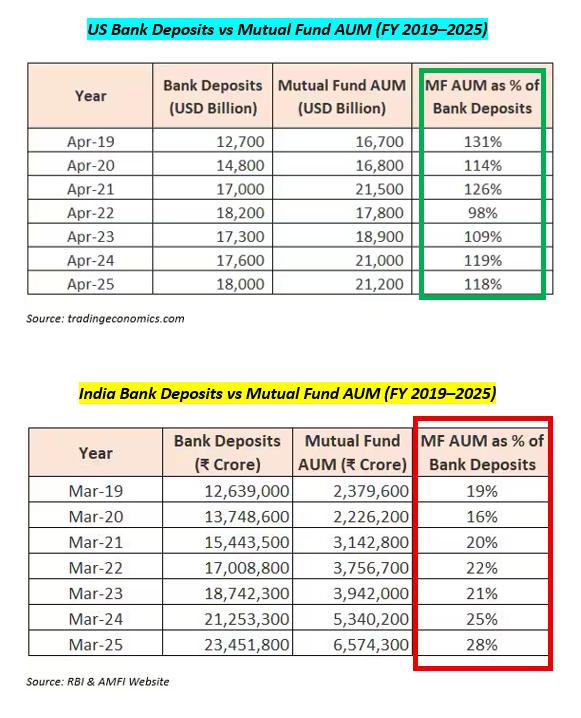
In the United States, mutual funds have long been a dominant investment channel. As per Trading Economics and Federal Reserve data, the mutual fund industry’s assets are almost on par with, and in many years exceed, bank deposits.
Year Bank Deposits (USD Billion) Mutual Fund AUM (USD Billion) MF AUM as % of Bank Deposits
Apr-19 12,700 16,700 131%
Apr-20 14,800 16,800 114%
Apr-21 17,000 21,500 126%
Apr-22 18,200 17,800 98%
Apr-23 17,300 18,900 109%
Apr-24 17,600 21,000 119%
Apr-25 18,000 21,200 118%
👉 Takeaway: In mature markets like the US, investors allocate aggressively towards equity and mutual funds. The industry is as large as the deposit base, reflecting deep financialisation and trust in capital markets.
India: Mutual Funds Still Catching Up
In India, the story is still unfolding. For decades, savings habits have leaned heavily toward bank deposits, gold, and real estate. Mutual funds, while growing rapidly, still form a smaller share compared to deposits.
Year Bank Deposits (₹ Crore) Mutual Fund AUM (₹ Crore) MF AUM as % of Bank Deposits
Mar-19 1,26,39,000 23,79,600 19%
Mar-20 1,37,48,600 22,26,000 16%
Mar-21 1,54,43,500 31,82,600 20%
Mar-22 1,70,08,800 37,56,700 22%
Mar-23 1,87,30,000 39,42,000 21%
Mar-24 2,13,25,800 53,04,200 25%
Mar-25 2,34,51,800 65,74,800 28%
👉 Takeaway: In FY 2025, India’s mutual fund AUM reached ₹65.74 lakh crore, which is about 28–30% of bank deposits. While this is a big jump from just 16% in FY 2020, there is still a long runway ahead.
Why the Gap Exists
1. Cultural Preference for Safety: Indian households value guaranteed returns and capital safety, making bank deposits a default option.
2. Financial Awareness: Mutual funds are still seen as “risky” by many, despite SEBI regulations and diversification benefits.
3. Taxation & Convenience: Bank deposits are simple and familiar, while mutual funds require understanding of risk-return dynamics.
4. Historic Performance: With falling interest rates and rising equity markets, awareness about SIPs and long-term wealth creation is now improving.
The Road Ahead
- Growing Investor Base: India now has over 4 crore unique mutual fund investors, a number rising rapidly.
- Shift in Savings Pattern: With FD interest rates in the 5–7% range and equity-oriented funds delivering 12–15% CAGR over long horizons, investors are gradually shifting.
- Policy Push: Initiatives like AMFI’s “Mutual Funds Sahi Hai” campaign and digitisation of KYC/onboarding are accelerating adoption.
- Global Benchmark: If India follows the US trajectory, mutual fund AUM could one day equal or surpass bank deposits. Even reaching 50% of deposits in the next 10 years would imply trillions of rupees flowing into capital markets.
Conclusion
India’s mutual fund industry is on a powerful growth trajectory. While today MF AUM is about 28–30% of bank deposits, compared to over 100% in the US, the gap represents untapped potential.
For investors, this means:
- Mutual funds are becoming mainstream.
- Long-term SIPs can benefit from the industry’s growth.
- As awareness grows, India is moving steadily towards a more “financialised” economy.
The journey from “Bank Fixed Deposits” to “Equity Mutual Funds” is not about abandoning safety—it’s about balancing safety with long-term growth.
📢 Disclaimer: Mutual Fund investments are subject to market risks. Read all scheme-related documents carefully before investing. Past performance is not indicative of future results.
🏆 Receiver of “Excellence in Financial Product Distribution & Wealth Solutions – ET Now Business Conclave & Awards 2025”
Read More →

Category
Mutual Fund
Title: Your Salary is Not Your Wealth — Build Real Assets, Not Just Income!
Rishabh Finvest | Let’s Grow Together
💼 Introduction
The excitement of receiving your first salary is unmatched. It feels like freedom, validation, and potential all rolled into one. But what you do with your first few paychecks can set the tone for your financial future. In a world that’s quickly moving away from traditional tax-saving strategies, this is your chance to be smarter and more intentional. Let’s talk about how to invest—not just to save tax—but to grow wealth sustainably and efficiently.
📊 1. Understand the Tax Landscape First
With the increasing adoption of the new tax regime, most traditional tax-saving investments under Section 80C (like PPF, ELSS, Life Insurance, etc.) are no longer relevant for many taxpayers—especially if you opt for the new structure.
🔍 So, what should you focus on?
✅ Tax efficiency (not just saving tax)
✅ Long-term growth
✅ Liquidity and diversification
🛡️ 2. NPS: The Only Long-Term Saver That Still Offers Tax Relief
Even under the new tax regime, the National Pension Scheme (NPS) continues to offer tax benefits under Section 80CCD(1B), up to ₹50,000. That’s a smart way to reduce tax and simultaneously build your retirement corpus.
💡 Bonus: NPS has partial equity exposure too—helping you beat inflation over the long run.
📈 3. Why Equity Deserves a Bigger Seat at the Table
You might’ve heard—"Equity is risky." But not investing in equity is riskier, especially in your 20s and 30s. Here’s why:
🚀 Inflation-beating returns: Historically, Indian equities (Nifty/Sensex) have delivered ~12% CAGR over 10–15 years.
💸 Lowest tax on returns (as per July 2024 revision):
LTCG exceeding ₹1.25 lakh taxed at 12.5% if sold on or after 23 July 2024
STCG taxed at 20% for sales made on or after 23 July 2024
✅ Despite the hike, equity remains one of the most tax-efficient instruments when compared with FDs, real estate, and even gold.
💰 4. Build Real Assets, Not Just Expenses
Your salary should fund assets that grow—not just EMIs or weekend dinners. A few smart moves:
🔁 Start a SIP (Systematic Investment Plan) in an equity mutual fund
💼 Allocate 10–15% of your income to long-term wealth-building instruments
🛟 Keep an emergency fund ready (3–6 months of expenses)
📌 Remember: Every rupee saved and invested is a step toward financial independence.
🧠 5. Mindset > Money
Your wealth-building journey starts with discipline, not income. Whether your salary is ₹20,000 or ₹2,00,000—if you don’t invest it, you’re only working for money. But if you invest it, your money starts working for you.
🌱 Let your 20s be the decade of intentional choices—where every salary isn’t just spent, but sown. Because real wealth isn’t what comes into your account—it’s what stays, grows, and secures your future.
🔖 #LetsGrowTogether
Read More →

Category
Mutual Fund
First salary — that moment of pride, independence, and freedom.
But along with it comes responsibility: how you manage and grow your money from the very beginning will define your financial future.
If you’re a young professional just starting your career, this blog is for you! Here are practical, simple investment lessons that can help you build wealth — safely and smartly.
1. **Save Before You Spend — Not the Other Way Around**
Your first instinct may be to spend — shopping, gadgets, vacations. But remember: wealth is built by saving a portion of what you earn first, and then spending the rest.
Tip: Allocate at least 20–30% of your income towards savings and investments as soon as you receive your salary.
2. **Start Investing Early — Time is Your Best Friend**
The sooner you start investing, the greater the impact of compounding. Even small SIPs (Systematic Investment Plans) of ₹2,000–₹5,000 per month can turn into lakhs over 10–20 years.
3. **Avoid “Quick Rich” Temptations**
Trading, speculation, and shortcuts can lure you — especially with social media showing overnight “successes”. Real wealth is created patiently.
Tip: Focus on long-term equity mutual funds, hybrid funds, and avoid frequent churning.
4. **Get a Health Insurance Policy Early**
At this stage you may feel “too young” for insurance — but buying health cover now ensures lower premiums and lifelong coverage.
5. **Build an Emergency Fund**
Before you think of big investments, create an emergency fund covering 3–6 months of expenses. This ensures that unexpected events don’t force you to break your investments.
6. **Understand the Power of SIPs**
SIPs are ideal for salaried youth — they:
* Instill financial discipline
* Smooth out market volatility
* Start small and grow gradually.
7. **Seek Professional Guidance Early**
Even if you’re starting small, get your basics right.
Talk to a professional — not just random advice on social media.
At Rishabh Finvest, we help young investors make informed, safe, and compliant investment decisions — no trading, no speculation, just a clear path to growth.
Your first job is not just the start of your career — it’s the perfect opportunity to start your financial journey right.
Every rupee invested today can make your future self thankful tomorrow!
Read More →

Category
Mutual Fund
**How to invest in mutual funds without any prior knowledge about it?**
Investing in mutual funds can be a smart way to grow your wealth, even if you have no prior knowledge of the financial markets. Here's a step-by-step guide on how to start your mutual fund investment journey without any prior expertise.
**1. Educate Yourself:** The first and most crucial step is to educate yourself about mutual funds. A mutual fund is a pool of money collected from many investors which is managed by a professional fund manager. The manager invests the pooled money in a diversified portfolio of stocks, bonds, or other securities.
There are various types of mutual funds, such as equity funds, debt funds, hybrid funds etc. each with its own risk and return profile. Take some time to read articles, watch videos, and gain a basic understanding of these concepts.
**2. Set Clear Financial Goals:** Determine your investment goals. Are you investing for retirement, a major purchase, or simply to grow your wealth? Knowing your objectives will help you choose the right type of mutual fund and develop a strategy.
**3. Seek Professional Guidance:** If you're unsure about where to start, it's highly recommended to seek professional guidance. An expert can assess your financial situation, risk tolerance, and investment goals, and suggest suitable mutual funds thus reducing costly financial mistakes.
**4. Select a Mutual Fund:** Always makes sure that you choose a mutual fund that aligns with your investment goals and risk tolerance.
**5. Open an Investment Account:** To invest in mutual funds, you'll need to open an investment account. The account setup process is typically straightforward and involves providing some personal and financial information. The platform you choose will guide you through the necessary steps.
**6. Start with a Small Investment:** It's a good idea to start with a small amount of money, especially if you're new to investing. Many mutual funds have a minimum investment requirement, which can vary from scheme to scheme and AMC to AMC too. Make sure to check this requirement and ensure that it fits your budget. Starting small helps you understand how investing works without risking a lot of money.
**7. Monitor your investments:** After investing in a mutual fund, it's crucial to review your portfolio. You can track your investments through the online platform where you opened your account. Check the performance of your funds periodically and compare it to your investment goals. Be prepared to make adjustments to your portfolio if your goals change or if a fund consistently underperforms.
**8. Continuous Learning:** Investing is an ongoing process. As you gain more experience, continue to educate yourself about mutual funds and investment strategies. Read books, attend seminars, and stay updated with financial news. The more you learn, the better equipped you'll be to make informed investment decisions.
Investing in mutual funds without knowledge is possible, but it's important to know that all investments have risks. Mutual funds too can fluctuate in value, and it's possible to lose money.
If you ever feel uncomfortable making investment decisions on your own, don't hesitate to seek professional guidance. Education, planning, and expert advice can lead to a successful mutual fund investment journey.
Read More →

Category
Mutual Fund
Financial freedom is a dream for many, where you have the resources and flexibility to live life on your terms. While it may seem like an elusive goal, mutual funds can be a powerful tool to help you achieve this aspiration. In this blog, we will explore how mutual funds can contribute to your journey to financial freedom.
**→ Diversification and Risk Management**
One of the fundamental advantages of mutual funds is their ability to diversify your investments. Diversification means spreading your money across a range of assets, such as stocks, bonds, commodities. By investing in a mutual fund, you become a part of a larger pool of investors, which, in turn, allows the fund manager to diversify your investments effectively. This diversification helps to reduce the impact of poor-performing assets and manage risk.
**→ Professional Management**
Mutual funds are managed by experienced fund managers who make investment decisions on your behalf. These professionals are equipped with the knowledge and expertise to navigate the complex world of financial markets. They conduct research, analyze market trends, and strategically allocate the fund's assets to maximize returns while mitigating risks. This professional management ensures that your investments are in capable hands.
**→ Accessibility**
Unlike some investment options that require substantial initial capital, mutual funds offer accessibility to a wide range of investors. You can start investing with a relatively small amount of money. This accessibility makes mutual funds an attractive choice for individuals at various stages of their financial journey.
**→ Liquidity**
Mutual funds provide liquidity, meaning you can easily buy or sell your units. This flexibility ensures that you have access to your money when you need it. Whether you're saving for short-term goals or maintaining an emergency fund, mutual funds allow you to maintain financial flexibility.
**→ Automatic Investment with SIPs**
Achieving financial freedom often requires discipline and consistent saving. Mutual funds offer a solution through Systematic Investment Plans (SIPs). SIPs allow you to set up automatic, periodic investments, helping you save and invest consistently. Over time, this disciplined approach can significantly increase your wealth.
**→ The Power of Compounding**
Mutual funds harness the power of compounding, which can significantly impact your wealth over time. As your investments generate returns, those returns are reinvested, and your investment base grows. This leads to exponential growth and can be a key driver in achieving your financial goals.
**→ Flexibility**
Mutual funds come in various categories and cater to different investment goals. Whether you're saving for retirement, your child's education, or buying a home, there is likely a mutual fund category that aligns with your specific financial objectives. This flexibility allows you to tailor your investments to meet your unique needs.
**→ Transparency**
Investors receive regular updates on their mutual fund investments, ensuring transparency. You can easily track the performance of your investments and make informed decisions about your portfolio.
**→ Tax Benefits**
Certain mutual funds offer tax advantages. For example, Equity-Linked Savings Schemes (ELSS) can provide tax deductions under Section 80C of the Income Tax Act.
→ Goal-Oriented Investing
Mutual funds can be a vital tool for goal-oriented investing. Choose funds that match your financial goals to help you reach them in an organized way. This approach ensures that you are not just saving money but actively working towards your aspirations.
**Conclusion**
Financial freedom is not a distant dream; it's a tangible goal that you can work towards with the help of mutual funds. Through diversification, professional management, accessibility, liquidity, compound growth, and other advantages, mutual funds provide a path to financial independence. To make the most of this investment option, it's essential to select funds that match your risk tolerance, time horizon, and financial objectives. Regularly reviewing your investments and staying committed to your goals will help you realize your vision of financial freedom. So, start your mutual fund journey today and take the first step towards achieving your financial aspirations.
Read More →
